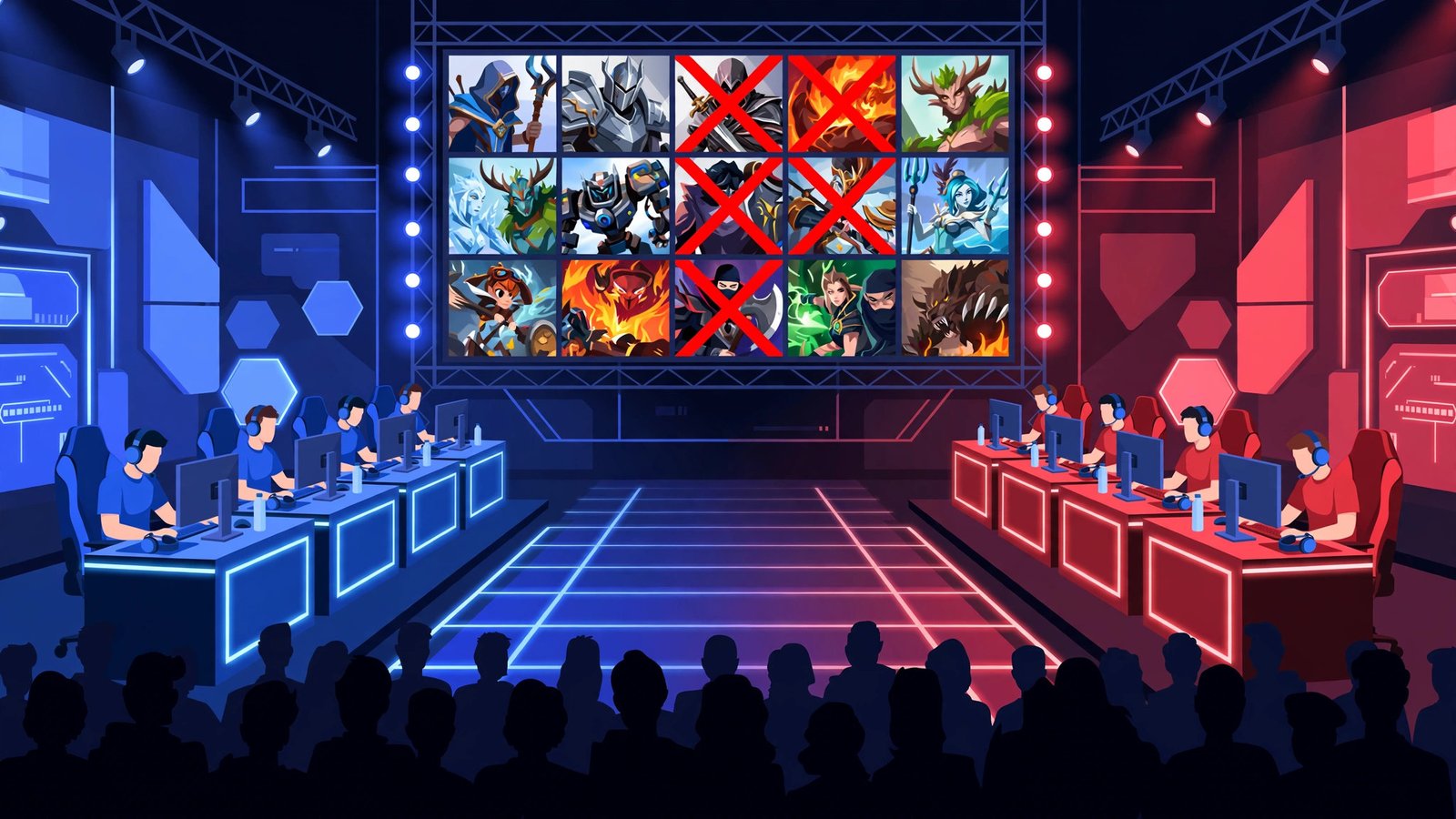
In League of Legends esports, champion draft is the pick-and-ban phase before each game: two teams take turns banning and picking champions in four phases — ten bans and ten picks in total. Blue side gets the first pick, red side gets the last pick, and the draft often decides the game before it starts.
If you have ever heard casters say “draft diff” after a 25-minute stomp, this is what they mean. The game was not lost in a team fight — it was lost in the three minutes before it started, when one team walked away with a composition that did what it wanted and the other walked away with five champions that did not fit together.
How Does Champion Draft Work in League of Legends Esports?
The draft follows a fixed sequence. Once you know it, you can follow any pro draft in real time.
Ban phase 1: Blue bans one, red bans one, alternating until each team has banned three — usually the opponent’s signature champions or the strongest champions on the current patch.
Pick phase 1: Blue picks one, red picks two, blue picks two, red picks one. Each team now has three champions. First pick usually goes to the strongest champion still available, the “power pick”, while the next picks secure a team’s core lane or jungle pairing.
Ban phase 2: Red bans one, blue bans one, red bans one, blue bans one, targeting the lanes still unpicked — usually top lane or support, where teams hide their final picks.
Pick phase 2: Red picks one, blue picks two, red picks one. Each team now has five champions, and the game starts.
Two details matter most. Blue side picks first, so blue gets the best available champion uncontested. Red side picks last, so red gets the final counterpick — usually a top laner chosen to beat whatever blue already locked in.
What Is Side Selection, and Why Does Blue Side Win More?
Before each game, one team chooses which side of the map to play on. In game one, side selection is usually decided by a coin flip or by seeding; in later games, the team that lost the previous game typically gets to choose.
Blue side is widely considered the stronger side, and the statistics back it up — across most pro leagues, blue side wins roughly 52 to 55 percent of games. Blue gets first pick, meaning the best champion on the patch, plus a slightly easier route to the early dragon pit.
Red side’s compensation is the last pick. A team that trusts its top laner can draft around that counterpick, winning a lane matchup blue could never answer. Some teams actively prefer red side for exactly this reason.
What Is a Team Composition, and How Do Coaches Build One?
A team composition — a “comp” — is the five champions taken together, judged by how they work as a unit rather than how strong each one is alone. Coaches build comps around a win condition: a specific way the team plans to win.
Team fight comps pick champions whose ultimates combine in one big fight around dragon and Baron. Dive comps pick mobile assassins and bruisers that jump onto the enemy backline and kill the carries first. Poke comps pick long-range mages and marksmen who wear the enemy down from a safe distance before a fight even starts. Split-push comps pick one champion who wins a side lane alone while the other four hold the rest of the map.
The mistake most viewers make is judging a draft champion by champion. A draft is not five good picks. It is five picks that answer the same question: how do we win, and when?
What Is Fearless Draft, and How Did It Change Pro Play?
Under fearless rules, any champion picked in an earlier game of a series cannot be picked again by either team in a later game. Bans still reset each game, but picks do not.
The LPL and LCK adopted fearless draft for the 2025 season, and it has spread across pro play since. The effect is dramatic: in a best-of-five, up to 40 champions can be removed from the pool by game five, so teams can no longer ride one comfort composition through a whole series.
How Do Coaches Actually Prepare a Draft?
Draft preparation starts long before match day. A coaching staff studies the opponent’s last several series and builds a profile: which champions each player prioritizes, which bans they respect, which lanes they play through, and which compositions they fall back on under pressure. From that profile, coaches build a draft plan with branches — if the opponent bans our first pick, we pivot to plan B; if they leave a power pick open, we take it.
During the draft itself, the head coach talks with the players over comms while the clock runs. The best drafters are not just knowledgeable; they are calm under that clock. They also read the opponent’s draft as it develops: a pick that looks harmless on its own can reveal the whole enemy game plan once the third pick lands. Flex picks help here too — a champion playable in two or three roles hides information, so the opponent cannot ban against it precisely.
The Mini-Test: Read a Draft Like a Coach in One Game
You do not need a coaching staff to practice draft reading. Do it during the next pro match you watch.
- After the draft finishes but before the game starts, write down each team’s win condition in one sentence — for example, “Blue wins by team fighting at dragon after 20 minutes.”
- Write down which team you think has the better draft and why, in one more sentence.
- Watch the first 15 minutes and check your prediction. Which team is playing toward its win condition?
Most viewers find their first few reads are wrong — and that is the lesson. A draft that looks winning on paper can be undone by a level-one invade or a jungler who reads the enemy pathing. The draft sets the plan; the players still have to execute it. After five or six games of this exercise, you will start seeing the patterns, and the draft screen will stop looking like a slideshow.
Why Does “Draft Diff” Decide So Many Pro Games?
“Draft diff” is the community’s shorthand for a game decided at champion select. It is real, but often overstated — a draft advantage is usually worth a few hundred gold of lane pressure and a clearer path to objectives, not a guaranteed win. What makes it decisive is that pro players are so evenly matched that small edges compound: a winning lane becomes a tower plate, then a dragon, then a Baron, then a game.
The Full Draft Sequence, Phase by Phase
A tournament draft has exactly twenty actions: ten bans and ten picks, spread over four phases that alternate between bans and picks. Blue side opens the draft with the first ban and the first pick; red side closes it with the last pick.
| Phase | Order | What happens |
|---|---|---|
| Bans 1 | Blue → Red, alternating | 6 bans (3 per team), before any pick |
| Picks 1 | Blue, Red, Red, Blue, Blue, Red | 6 picks |
| Bans 2 | Red → Blue, alternating | 4 bans (2 per team), after the first six picks |
| Picks 2 | Red, Blue, Blue, Red | 4 picks |
Picks are labelled by side: B1 to B5 for blue side, R1 to R5 for red side. The first pick phase gives B1, R1, R2, B2, B3, R3; the second gives R4, B4, B5, R5. The balance of the whole sequence comes down to one trade: blue side gets the first pick of the draft, red side gets the last.
What Each Side Actually Gets
The pick order decides what each team knows when it has to choose. Blue side leads the rhythm of the draft and can secure the single strongest champion before anyone else — the first pick (B1). Its price is that its last two picks (B4 and B5) come before red side’s final pick, so when red side makes its last choice, blue side’s composition is already complete and fully visible. Red side drafts by reaction: it sees more before choosing, can line up more counters, and keeps a flex pick — a champion playable in several roles — hidden until the very last pick (R5), leaving the opponent guessing where that champion will play. Neither side is simply better; the advantage depends on the matchup, the champion pool, and which team prepared better.
Tournament Draft vs Solo Queue Draft
The draft you play in ranked solo queue is not the tournament draft. They share the idea — bans, then picks — but the sequence is different, and knowing the difference stops a lot of confusion when you watch pro play.
| Tournament draft | Solo queue draft | |
|---|---|---|
| Bans | 10, in two phases, alternating | 10, in one phase, simultaneous |
| Duplicate bans | Impossible — every ban is visible | Possible — both teams can ban the same champion |
| Pick order | Fixed, B1 to R5 | Swappable between allies |
| Positions | Decided by the team | Chosen before the queue; autofill possible |
| Fearless draft | Possible in a series | Not applicable — every game stands alone |
In solo queue, before the match each player lists two preferred positions (or picks Fill), then all ten players ban one champion each at the same time, and picks are made turn by turn with a short timer per turn. In a series, the team that lost the previous game chooses its side for the next one — and under Fearless draft, champions picked in earlier games of the series cannot be picked again, so the champion pool shrinks with every game and blue side’s first pick becomes more valuable.
Frequently Asked Questions
How does champion draft work in League of Legends esports?
Champion draft in pro League is a pick-and-ban phase: each team bans five champions, then the teams alternate picks until both have five. Blue side picks first and red side picks last, getting the final counterpick. In fearless draft series, champions picked in earlier games cannot be picked again later in the series.
How many bans are there in a pro League of Legends draft?
Each team bans five champions per game — three in the first ban phase and two in the second — for ten bans total. Under fearless draft rules, champions picked in previous games of the series are also unavailable, on top of the ten bans.
Why is blue side better than red side in League of Legends?
Blue side gets first pick, giving it the strongest available champion uncontested, plus a slightly favorable map layout around the early dragon pit. Red side’s advantage is the last pick, usually a top-lane counterpick. Overall, blue side wins roughly 52 to 55 percent of pro games.
What is fearless draft in League of Legends?
Fearless draft means any champion picked in an earlier game of a series cannot be picked again by either team in a later game. It was adopted by the LPL and LCK for the 2025 season and forces teams to show champion-pool depth instead of repeating one winning composition.
How many bans and picks are there in a pro League of Legends draft?
Twenty actions in total: ten bans and ten picks, in four phases. Six bans come before any pick, then six picks, then four more bans, then the last four picks.
Who bans first in a LoL draft?
Blue side makes the first ban of phase 1, and bans then alternate until six are done. In phase 2, red side makes the first of the last four bans — the order flips between phases.
Why are there two ban phases in League of Legends?
Because they are played with different information. The first six bans come before any pick, so they target strong champions or an opponent’s best picks. The last four bans come after six picks are visible, so they close off options those picks made possible — for example, banning the support that would complete the enemy’s composition.
How does draft work in solo queue compared to pro play?
In solo queue, all ten players ban one champion each at the same time, then picks are made turn by turn and allies can swap pick order. In pro play, bans and picks alternate between the two teams in four fixed phases, pick order is fixed, and there are no simultaneous bans.