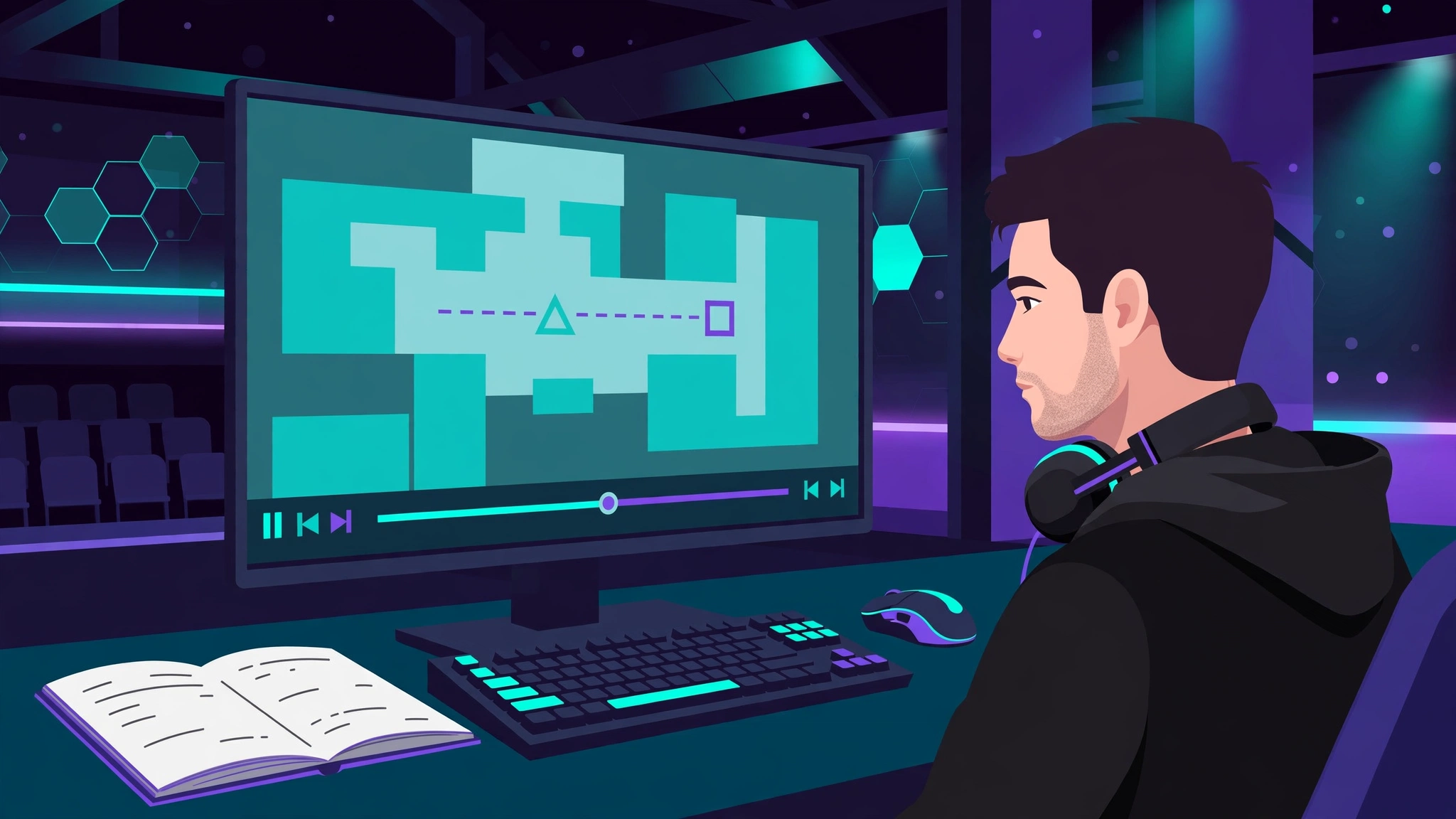
Most players who ask how to VOD review your own gameplay already record their matches — they just never watch them back. The replay sits in a folder, unwatched, while they queue again hoping the next game goes better. Pros do the opposite: a single 20-minute review session often teaches more than three hours of extra ranked games, because review is the only time you can see your decisions without the pressure of making them.
Learning how to VOD review your own gameplay is not about watching yourself lose in slow motion. It is a structured process: record the right footage, watch it with a specific question in mind, note exactly three fixable mistakes, and drill one of them before your next session. This guide gives you that process, built around a 20-minute framework you can run after every session.
What Is a VOD Review, Really?
A VOD review is a structured re-watch of your recorded gameplay with the goal of finding repeatable mistakes — not reliving highlights. “VOD” stands for video on demand, and in esports it usually means a recorded match or scrim. Coaches review VODs with pro teams to find patterns: a player who always over-peeks after winning a round, a team that loses the same retake setup twice in a row, a rotation that is always five seconds late.
The key word is structured. Watching a replay from start to finish and thinking “yeah, that was bad” is not a review — it is nostalgia with extra steps. A real review starts with a question, such as “why did I lose my opening duels?” or “where did our mid-round calls break down?” You watch to answer that question, and you stop when you have the answer.
Step 1: Record Every Match (Set It Up Once)
You cannot review what you did not record, so get the recording pipeline out of the way first. Most competitive players use one of three setups, and any of them works:
- OBS Studio (free): Set it to record at 1080p, 60 fps, with a replay buffer of at least the length of your longest match. Record your game capture plus your microphone — your comms are half the review.
- NVIDIA ShadowPlay / AMD ReLive: Instant replay features that save the last 20–30 minutes with one hotkey. Ideal if you only want to save losses or specific rounds.
- In-game replay systems: Valorant, CS2, and League of Legends all have built-in replay or match-history playback. These are best for reviewing positioning and rotations, because you can switch to any player’s perspective — but they usually do not include your voice comms.
One rule: record your comms. Most review value lives in the gap between what you said and what you did. If you called “I’m rotating B” and then stayed in A for ten more seconds, the audio catches the contradiction your memory will not.
Step 2: Pick One Match and One Question
Never review a match you won easily, and never review five matches at once. Pick one recent loss — ideally a close one, where small mistakes decided the outcome — and pick one question to answer. Good opening questions for your first reviews:
- Why did I die in my first three duels?
- Why did our attack rounds keep stalling?
- Where did I waste utility that could have won a round?
A single question keeps a 20-minute review from turning into an hour of drifting. If a second question pops up while you watch, write it down and save it for the next review — do not chase it mid-session.
Step 3: The 20-Minute VOD Review Framework
Here is the framework. Set a timer. Twenty minutes, no more.
Minutes 0–5: Watch at 2x Speed, Mark the Moments
Play the VOD at double speed and pause only when something important happens: deaths, lost rounds, failed executes, clutch moments. Drop a timestamped note for each one — a line in a notes app, a comment in your recording software, even a sticky note. You are building a map of the match, not analyzing yet. Most 40-minute matches compress to about five minutes of real events at 2x speed, and you will usually find six to ten marked moments.
Minutes 5–12: Rewatch the Three Worst Moments at Normal Speed
Pick the three marked moments that cost the most — the deaths that gave the enemy a numbers advantage, the round that swung the match. Watch each one at normal speed, from ten seconds before the mistake to ten seconds after. Ask three questions about each moment:
- What information did I have? Did I know where the enemy was, or did I guess?
- What decision did I make with it? Did I peek, rotate, hold, or use utility?
- What was the better option? Name it concretely — “hold the angle and wait for my teammate’s flash” beats “play smarter.”
This is where most players go wrong: they watch the death and conclude “I should have aimed better.” Aim is rarely the real lesson. Nine times out of ten, the mistake was positioning, timing, or information — the decision made before the aim duel started.
Minutes 12–17: Find the Pattern, Not the Blame
Look at your three moments together. Is there a pattern? Almost always, yes. Common patterns in ranked VOD reviews:
- Over-peeking after a win: You win a duel, feel confident, and peek a second angle you had no business taking.
- Utility panic: You throw smokes and flashes the moment you hear footsteps, instead of holding them for the execute.
- Silent rotations: You move across the map without telling your team, so nobody can trade your death.
- No plan after the plant: You plant the spike or take the objective and then improvise instead of playing the post-plant setup you practiced.
Write the pattern down in one sentence: “I over-peek after winning my first duel.” That sentence is the whole point of the review.
Minutes 17–20: Pick ONE Fix and Schedule the Drill
Choose exactly one fix — the pattern you just found — and decide how you will practice it before your next ranked session. Examples:
- Over-peeking → In your next three games, after winning a duel, you are not allowed to peek a second angle for five seconds. Count it out.
- Utility panic → In deathmatch warm-up, practice holding your utility until you see a target, not when you hear one.
- Silent rotations → Say your rotation out loud every single time, even in solo queue, even if nobody responds.
One fix. Not three. Players who try to fix everything after one review fix nothing — they just play scared for a game and then revert. One fix, drilled for a week, changes your rank. Three fixes, drilled for a day, change nothing.
What to Watch First (and What to Ignore)
If you are new to VOD review, prioritize in this order:
- Deaths that gave the enemy an advantage. Your first death in a round matters more than your third — it shapes everything after it.
- Round-losing decisions. The round you lost 4v2, the retake you rushed, the execute you abandoned.
- Utility usage. Watch when you used abilities and what they actually bought you. Most ranked players waste 30–40% of their utility on nothing.
And ignore these, at least at first:
- Your aim in isolated duels. Micro-aim improves through practice, not review. Review the decision that put you in the duel, not the flick itself.
- Your teammates’ mistakes. You cannot fix your teammates from a VOD. Review your own screen only.
- The final scoreline. A 13–4 loss and a 13–11 loss can teach the same lesson. The score is not the analysis.
The Mini-Test: Review One Loss Tonight
Here is a concrete test you can run tonight, in one session. Play your normal ranked games, then pick the closest loss. Run the 20-minute framework above and write down your one-sentence pattern and your one fix. Then, in your next session, play three games with only that fix in mind — nothing else. Before the third game, check: did the fix hold under pressure, or did you forget it the moment a round got tense?
Most players discover two things from this test. First, their pattern is embarrassingly consistent — the same mistake, three rounds in a row, invisible while playing and obvious on replay. Second, one fix genuinely changes how their games feel within a single session. That is the moment VOD review stops being homework and becomes the fastest way to climb.
How Often Should You Review?
For most ranked players, two or three 20-minute reviews per week beats a daily marathon. Review after a session, not before one — tired eyes miss patterns. And never review immediately after a tilt-inducing loss; wait until you can watch a death without arguing with the screen. A review done angry is just a second loss.
As you climb, shift the balance: lower-ranked players get the most from reviewing their own deaths, while higher-ranked players get more from reviewing team rounds — executes, retakes, and mid-round calls. The framework stays the same; only the question changes.
FAQ
How long should a VOD review take?
About 20 minutes for a single match. Longer reviews produce diminishing returns — after 20 minutes you start rewatching highlights instead of finding mistakes. If you need more time, you are reviewing too many matches at once. One match, one question, 20 minutes.
Do I need special software to VOD review my own gameplay?
No. OBS Studio is free and records everything you need, including your comms. In-game replay systems in Valorant, CS2, and League of Legends work too, though they usually lack voice audio. The software matters far less than the structure — a phone note with timestamps beats an expensive tool used without a plan.
Should I review wins or losses?
Losses, especially close ones. Wins hide mistakes behind a good scoreline, and blowout losses usually have too many problems to isolate one pattern. A close loss — the 11–13, the overtime defeat — is where one or two fixable decisions decided the outcome, and that is exactly what a review is for.
Can VOD review really help me climb ranked?
Yes, and it is one of the highest-return habits in competitive gaming. Ranked games give you experience; reviews turn that experience into correction. Players who review consistently fix the specific decision errors that keep them hardstuck, while players who only grind repeat the same mistakes with better aim.