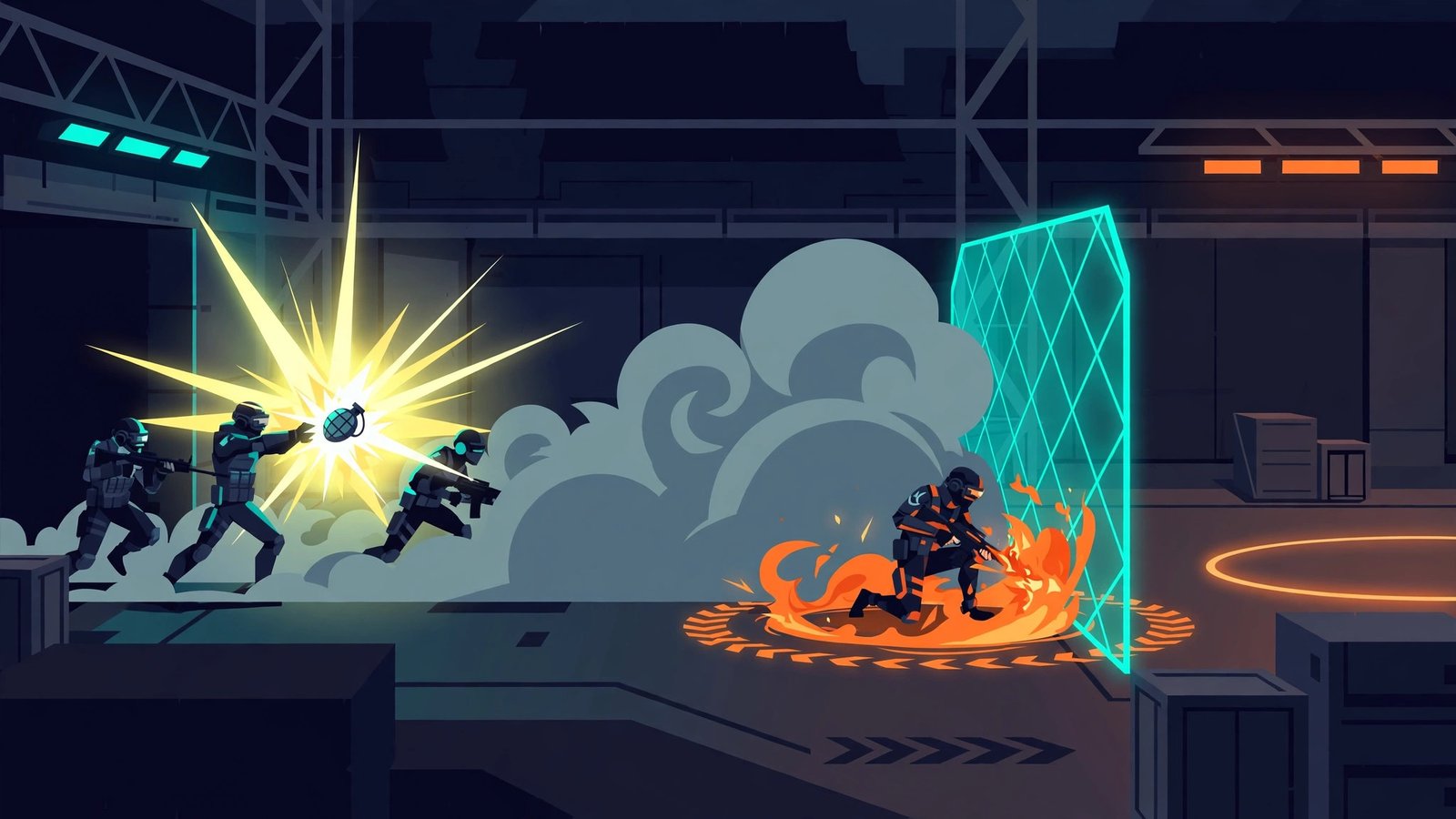
Utility usage in Valorant is the skill of spending your agent’s abilities — smokes, flashes, mollies, walls, and recon — to create an advantage for your team, rather than just throwing them whenever they come off cooldown. Good utility usage wins rounds before a single shot is fired: it blinds the defender holding an angle, blocks the sightline covering a choke point, or forces an enemy out of a corner they were never going to leave. If you have ever watched a pro team take a site and wondered why it looked so easy, the answer was almost never aim. It was utility.
What Counts as Utility in Tactical Shooters?
In tactical shooters like Valorant and Counter-Strike 2, “utility” means every ability or throwable that is not your gun. Guns deal damage directly; utility changes the conditions of the fight. Valorant splits it across agent roles, and each type does a different job:
Smokes block vision. They let your team cross open ground, plant the spike, or cut off a defender’s angle without taking a duel you would lose.
Flashes blind enemies for a few seconds. A well-timed flash turns a defender holding a tight angle into a free kill for your entry player.
Mollies (molotovs, incendiary grenades, Snake Bites) deny space. They force enemies out of corners, delay a defuse, or stop a rush dead in a choke point.
Walls and barriers reshape the map. A Sage wall or a Harbor wall creates cover where none existed, splitting a site into pieces your team can clear one at a time.
Recon and intel tools reveal enemies. A Sova dart or a Cypher camera tells your team where the fight actually is, so nobody walks blind into a stacked site.
The key insight is that none of these tools wins a round on its own. A smoke with nobody behind it is just a grey cloud. Utility only becomes powerful when paired with a plan: someone moves, someone trades, someone plants — while the enemy is blind, blocked, or flushed out.
Why Do Ranked Players Waste Their Utility?
Most ranked players do not have a utility problem; they have a timing problem. The same three mistakes show up constantly: throwing utility the moment the round starts, before anyone knows where the enemy is; saving it for a “perfect moment” that never comes and dying with a full kit; and, most commonly, using it for yourself alone — a smoke to hide your own peek, a flash to win your own duel, with no teammate positioned to benefit.
Pro teams think about it the other way around. The in-game leader decides which site the team will hit, then each player’s utility gets a job: one smoke cuts off the defender rotation, one flash clears the close corner, one molly stops the retake push. Every piece is spent in service of the team’s plan, not a personal highlight.
A small test in my own ranked games made this obvious. For ten matches I noted after each round whether my utility had directly helped a teammate or only myself. In the “helped a teammate” rounds, my team won roughly twice as often — not because the utility was mechanically better, but because it was connected to what the rest of the team was doing. Utility usage in Valorant is a team skill disguised as a personal one.
How Should You Use Smokes?
Smokes are the most misused utility in ranked play, because they look simple: throw a ball of smoke, block a sightline, walk through. The mistake is smoking the wrong sightline — usually the one directly in front of you, which blocks your own team’s vision as much as the enemy’s.
A good smoke answers one question: what angle is stopping my team from moving? If a defender on an elevated position covers the site entrance, smoke that defender, not the entrance itself. Smoke the enemy, not your own path. In a classic site execute, one smoke lands on the defender’s perch and another cuts off the rotation route — now the site defenders are isolated, rotators cannot see in, and your team can plant in relative safety.
One more rule: never smoke a choke point your team still needs to see through, and call the smoke before you throw it (“smoking heaven”) so teammates can adjust.
How Should You Use Flashes?
Flashes are the highest-value, highest-risk utility in the game. A perfect flash wins a site entry outright; a bad flash blinds your own entry player and hands the round to the enemy. The difference is almost always coordination.
The golden rule of flashing is simple: flash for someone else, not for yourself. The flasher should almost never be the first player through the doorway. Instead, the flasher throws, the entry player swings a half-second later, and the blinded defender faces a player who is already moving. Trying to flash and peek yourself usually means arriving while the enemy can still see — or flashing yourself on a wall.
Practice this in a duo first: one player calls “flashing now,” throws, and the other swings on the call. After ten repetitions you will feel the timing. That half-second window is the entire skill.
What About Mollies, Walls, and Recon?
Mollies reward patience. The best molly is thrown the moment the enemy has committed, not at the start of a fight. A molly on a spike plant forces the defuser to choose between taking damage and abandoning the defuse; one in a choke point during a retake splits the enemy team. Save at least one molly for the post-plant or the retake, not the entry.
Walls are about geometry, not blocking. A wall straight across a doorway delays everyone equally; a wall at an angle creates a one-way advantage, letting your team see around one edge while the enemy cannot see past it. Find two or three wall placements you trust in custom games.
Recon is the cheapest advantage in the game and the most ignored. A dart or camera revealing two enemies on a site before your team commits saves more rounds than any flash, because it stops your team walking into a stack. Use recon before the execute, not during it — information is only useful while there is still time to change the plan.
How Do You Practice Utility Usage Without a Team?
You do not need a five-stack to get better. A focused 20-minute routine, three times a week, builds the muscle memory ranked play never will:
Pick one map and one agent. Learn three smokes, two flashes, and one molly lineup on that map — no more. Depth beats breadth.
Practice in a custom game. Throw each piece of utility ten times until the lineup is automatic, then practice it while moving, the way a real round demands.
Play one ranked game with a single rule: every piece of utility you throw must be announced to your team first (“smoking B main,” “flashing site”). The announcement forces you to think about purpose before you throw.
Review one round per match. Ask a single question: did my utility help a teammate do something, or did it only help me? Keep the honest answer in mind next game.
Within a couple of weeks, you will notice the shift: your utility stops being something you throw because it is available, and starts being the reason your team wins rounds that used to feel unwinnable. That is what separates a player with good aim from a player who actually climbs — the second player makes the whole team more dangerous.
FAQ
What is utility usage in Valorant?
Utility usage in Valorant is how you spend your agent’s abilities — smokes, flashes, mollies, walls, and recon — to create advantages for your team, such as blocking sightlines, blinding defenders, denying space, or revealing enemy positions. Good utility usage is timed with your team’s plan, not thrown randomly whenever abilities come off cooldown.
How do I get better at utility usage in Valorant?
Focus on one map and one agent, learn a handful of lineups deeply, and announce every piece of utility before throwing it. Review one round per match and ask whether your utility helped a teammate, not just yourself.
Should I save my utility or use it early in a round?
Neither extreme works. Throwing everything at round start wastes utility before you know where the enemy is, while dying with a full kit wastes it entirely. Spend utility when it serves a specific job, and save at least one piece for the post-plant or retake.
What is the most important utility in Valorant?
Smokes, because they control vision — the most valuable resource in a tactical shooter. A well-placed smoke isolates defenders, protects a plant, and lets your team move without taking unfair duels — but only when teammates are ready to move behind it.